



Introduction
The digital world is growing faster than ever before. Every day, billions of people stream videos, use cloud services, interact with artificial intelligence systems, and transfer massive amounts of data online. Traditional electronic chips are reaching their physical and performance limits, creating a need for a new technology capable of handling higher speeds and larger bandwidth with lower energy consumption. This is where silicon photonics enters the picture as one of the most groundbreaking innovations in modern computing and communication.
Silicon photonics combines optical communication with traditional silicon-based semiconductor manufacturing. Instead of using electrical signals to transfer data, this technology uses light signals. Because light travels significantly faster and with less heat generation, silicon photonics can dramatically improve data transfer speed, reduce power consumption, and enhance overall computing efficiency.
In recent years, major technology companies and research institutions have invested heavily in silicon photonics because it offers solutions to some of the biggest challenges in data centers, telecommunications, artificial intelligence, and high-performance computing. As internet usage continues to rise and AI models become increasingly complex, the demand for faster and more efficient communication systems will continue to increase.
This article explores the fundamentals of silicon photonics, how it works, its advantages, applications, challenges, future potential, and why it is becoming one of the most important technologies of the modern digital era.
What Is Silicon Photonics?
Silicon photonics is a technology that uses light to transmit data through silicon chips. It integrates optical components such as lasers, modulators, waveguides, and photodetectors onto a silicon semiconductor platform. The main goal of silicon photonics is to replace or supplement traditional electrical data transmission methods with optical communication.
Traditional electronic systems rely on electrons moving through copper wires to transfer information. However, electrical communication faces limitations such as signal interference, energy loss, heat generation, and slower speeds over long distances. Silicon photonics addresses these issues by using photons, or light particles, instead of electrons.
The technology is based on the same silicon manufacturing techniques used in the semiconductor industry. This compatibility allows manufacturers to produce optical communication components using existing fabrication facilities, which significantly reduces production costs and improves scalability.
By integrating optics directly into semiconductor chips, silicon photonics enables extremely high-speed communication while maintaining energy efficiency. This makes it highly attractive for modern computing systems that require massive data processing capabilities.
How Silicon Photonics Works
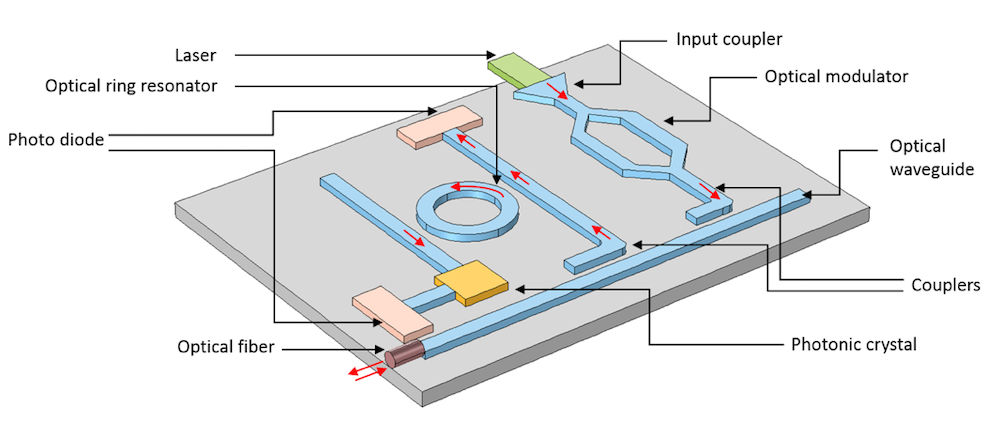
To understand silicon photonics, it is important to understand the basic principles behind optical communication.
In a silicon photonics system, electrical signals are first converted into optical signals using a laser source. These optical signals travel through tiny optical pathways called waveguides that are built directly into the silicon chip. Special devices called modulators encode information onto the light waves, allowing data transmission at extremely high speeds.
At the receiving end, photodetectors convert the optical signals back into electrical signals that computers and electronic devices can process.
Several important components make this process possible:
Lasers
Lasers generate the light used for communication. The light acts as the carrier of information. Some silicon photonics systems use external lasers, while others integrate laser components directly into the chip.
Waveguides
Waveguides are tiny pathways that guide light signals through the silicon chip. They function similarly to wires in electronic systems but carry photons instead of electrons.
Modulators
Modulators encode digital data onto light signals. They rapidly adjust the properties of the light, such as intensity or phase, to represent information.
Photodetectors
Photodetectors receive optical signals and convert them back into electrical signals for processing by electronic systems.
Multiplexers
Multiplexers combine multiple optical signals into a single communication channel, increasing bandwidth and improving transmission efficiency.
Together, these components create an integrated optical communication system capable of transmitting enormous amounts of data at very high speeds.
The Importance of Silicon Photonics in Modern Technology
The demand for data transmission has increased exponentially due to cloud computing, artificial intelligence, streaming services, online gaming, and connected devices. Traditional electrical communication systems struggle to keep up with this growing demand.
Silicon photonics is becoming increasingly important because it offers solutions to several critical technological challenges.
Faster Data Transfer
One of the biggest advantages of silicon photonics is speed. Optical communication can transfer data much faster than traditional copper-based electrical systems. This is especially important for modern data centers and AI systems that process huge amounts of information every second.
Lower Energy Consumption
Electronic communication systems consume significant amounts of power and generate heat. Silicon photonics reduces energy consumption because light transmission is more energy efficient than electrical transmission.
Reduced Heat Generation
Heat is a major problem in modern computing systems. Excessive heat reduces performance and increases cooling costs. Since optical signals generate less heat, silicon photonics helps improve thermal efficiency.
Higher Bandwidth
Bandwidth refers to the amount of data that can be transmitted within a certain time period. Silicon photonics supports much higher bandwidth than traditional electrical interconnects.
Scalability
Because silicon photonics uses standard semiconductor manufacturing processes, it can be scaled for mass production more easily than many other optical technologies.
These benefits make silicon photonics highly attractive for industries that require fast and reliable communication systems.
Applications of Silicon Photonics
The applications of silicon photonics are expanding rapidly across many industries. Its ability to provide high-speed, energy-efficient communication makes it suitable for a wide range of advanced technologies.
Data Centers
Data centers are among the largest users of silicon photonics technology. Modern cloud computing services depend on massive data centers containing thousands of servers that constantly exchange information.
Traditional copper connections are becoming insufficient for handling growing data traffic. Silicon photonics enables ultra-fast optical interconnects that improve data center performance while reducing energy consumption.
Major cloud providers are increasingly adopting silicon photonics to improve scalability and efficiency.
Artificial Intelligence and Machine Learning
AI systems process enormous datasets and require extremely fast communication between processors, memory systems, and storage devices.
Silicon photonics supports the high-bandwidth communication needed for training and running complex AI models. It can significantly improve AI infrastructure performance while lowering power requirements.
As artificial intelligence continues to grow, silicon photonics is expected to become a critical component of future AI hardware systems.
Telecommunications
The telecommunications industry uses optical fiber networks to transfer data across long distances. Silicon photonics enhances telecommunications infrastructure by enabling faster and more compact optical communication devices.
It supports high-speed internet connectivity, 5G networks, and future communication technologies.
High-Performance Computing
Supercomputers and high-performance computing systems require rapid communication between processors. Silicon photonics reduces communication bottlenecks and improves processing efficiency.
This is especially important for scientific research, weather modeling, financial analysis, and complex simulations.
Consumer Electronics
Future consumer devices may also benefit from silicon photonics. Researchers are exploring ways to integrate optical communication into smartphones, laptops, augmented reality devices, and wearable technologies.
This could lead to faster devices with improved battery life and better performance.
Automotive Industry
Modern vehicles increasingly rely on sensors, cameras, and communication systems. Autonomous driving technology requires extremely fast data processing and communication.
Silicon photonics can support high-speed communication between vehicle systems and sensors, improving safety and performance.
Advantages of Silicon Photonics
The growing popularity of silicon photonics is largely due to its many advantages over traditional electronic communication systems.
Extremely High Speed
Light-based communication enables data transfer rates far beyond what electrical systems can achieve.
Energy Efficiency
Silicon photonics reduces power consumption, which is especially important for large-scale computing infrastructure.
Smaller Size
Optical components integrated onto silicon chips allow compact system designs.
Cost-Effective Manufacturing
Using existing semiconductor manufacturing processes lowers production costs and supports mass manufacturing.
Improved Reliability
Optical systems are less affected by electromagnetic interference, improving communication reliability.
Long-Distance Communication
Optical signals can travel long distances with minimal signal loss.
These advantages position silicon photonics as a key technology for future digital infrastructure.
Challenges Facing Silicon Photonics
Despite its enormous potential, silicon photonics still faces several technical and commercial challenges.
Laser Integration
Integrating efficient laser sources directly onto silicon chips remains difficult because silicon itself is not an ideal material for generating light.
Heat Management
Although silicon photonics generates less heat than electronic systems, thermal management is still important for maintaining optical performance.
Manufacturing Complexity
Producing highly precise optical components on silicon chips requires advanced manufacturing techniques and strict quality control.
Cost of Development
Research and development costs for silicon photonics systems can be high, especially for smaller companies.
Standardization Issues
Industry-wide standards for silicon photonics technology are still evolving, which can slow adoption and compatibility.
Packaging Challenges
Connecting optical components to external systems while maintaining signal quality remains technically demanding.
Researchers and companies are actively working to solve these challenges, and continuous progress is being made.
Silicon Photonics and the Future of AI
Artificial intelligence is one of the biggest drivers behind the growth of silicon photonics. AI models require enormous computational power and rapid data movement between processors.
Traditional electronic interconnects are becoming bottlenecks in AI systems. Silicon photonics offers a solution by enabling ultra-fast optical communication between computing components.
Future AI accelerators may rely heavily on optical communication to achieve better efficiency and scalability. Researchers are also exploring optical computing systems that use light not only for communication but also for actual data processing.
If successful, these technologies could revolutionize artificial intelligence hardware and dramatically improve AI performance.
The Role of Silicon Photonics in Data Centers
Modern data centers consume vast amounts of electricity. As cloud computing demand grows, operators face increasing pressure to improve energy efficiency and reduce operational costs.
Silicon photonics helps address these issues by enabling high-speed optical communication with lower power consumption.
Optical interconnects reduce latency, increase bandwidth, and improve overall network efficiency within data centers. This leads to faster cloud services, improved scalability, and reduced cooling requirements.
Many leading technology companies are already deploying silicon photonics solutions in their data center infrastructure.
Silicon Photonics vs Traditional Electronics
Comparing silicon photonics with traditional electronics highlights why the technology is gaining attention.
Traditional electronics rely on electrical signals moving through metal wires. While effective for decades, this approach faces limitations related to heat, speed, and energy efficiency.
In contrast, silicon photonics uses light for communication. Light signals experience lower resistance, travel faster, and generate less heat.
Electronic systems are still better for certain types of processing and memory operations, but optical communication is becoming increasingly important for high-speed data transfer.
The future will likely involve hybrid systems that combine electronics and photonics to achieve optimal performance.
Research and Innovation in Silicon Photonics
Research in silicon photonics is advancing rapidly worldwide. Universities, research institutions, and technology companies are exploring new materials, manufacturing methods, and device architectures.
Key areas of innovation include:
- Integrated laser technology
- Optical AI accelerators
- Quantum communication systems
- Advanced photonic packaging
- Optical memory systems
- Energy-efficient communication networks
Governments and private investors are funding large-scale research programs because silicon photonics is viewed as strategically important for future digital infrastructure.
As innovation continues, the technology is expected to become more powerful, affordable, and widely adopted.
The Future Potential of Silicon Photonics
The future of silicon photonics looks extremely promising. As demand for faster communication and more efficient computing continues to grow, optical technologies will become increasingly essential.
Several future developments may shape the industry:
Optical Computing
Researchers are developing systems that use light for both communication and computation. Optical computing could dramatically outperform traditional electronic processors.
Quantum Technologies
Silicon photonics may play an important role in quantum communication and quantum computing systems.
Faster Internet Infrastructure
Future internet networks may rely heavily on photonic technologies for ultra-fast global communication.
Advanced Medical Technologies
Silicon photonics could support medical imaging, diagnostics, and biosensing applications.
Smart Cities and IoT
The growing number of connected devices in smart cities and Internet of Things networks will require efficient communication systems that silicon photonics can provide.
The technology has the potential to transform many aspects of modern life.
Conclusion
Silicon photonics is emerging as one of the most important technologies of the modern digital age. By combining optical communication with silicon semiconductor manufacturing, it offers faster data transfer, lower power consumption, reduced heat generation, and higher bandwidth than traditional electronic systems.
As industries continue to demand greater computing power and communication efficiency, silicon photonics is becoming increasingly essential for data centers, artificial intelligence, telecommunications, high-performance computing, and future consumer technologies.
Although challenges such as laser integration and manufacturing complexity still exist, ongoing research and innovation are rapidly advancing the field. Major technology companies and research institutions are investing heavily in silicon photonics because of its enormous potential.
In the coming years, silicon photonics is expected to play a central role in shaping the future of computing, communication, and digital infrastructure. Its ability to support the growing demands of the modern world makes it a revolutionary technology with limitless possibilities.
Short Paragraph
Silicon photonics is transforming the future of communication technology by using light instead of electricity to transfer data. This innovative technology delivers faster speeds, lower energy consumption, and higher bandwidth, making it essential for AI systems, cloud computing, telecommunications, and next-generation data centers.
FAQs
1. What is silicon photonics used for?
Silicon photonics is used for high-speed data communication in data centers, telecommunications, artificial intelligence systems, cloud computing, and high-performance computing.
2. Why is silicon photonics important?
It is important because it enables faster data transfer, lower energy consumption, reduced heat generation, and higher bandwidth compared to traditional electronic communication systems.
3. How does silicon photonics work?
Silicon photonics works by transmitting information using light signals through optical components integrated onto silicon chips.
4. What industries benefit from silicon photonics?
Industries such as telecommunications, cloud computing, artificial intelligence, automotive technology, healthcare, and consumer electronics benefit from silicon photonics.
5. What is the future of silicon photonics?
The future of silicon photonics includes applications in optical computing, quantum communication, advanced AI systems, faster internet infrastructure, and next-generation electronic devices.
You May Also Read
for more updates come back to our website newsatacker.blog
